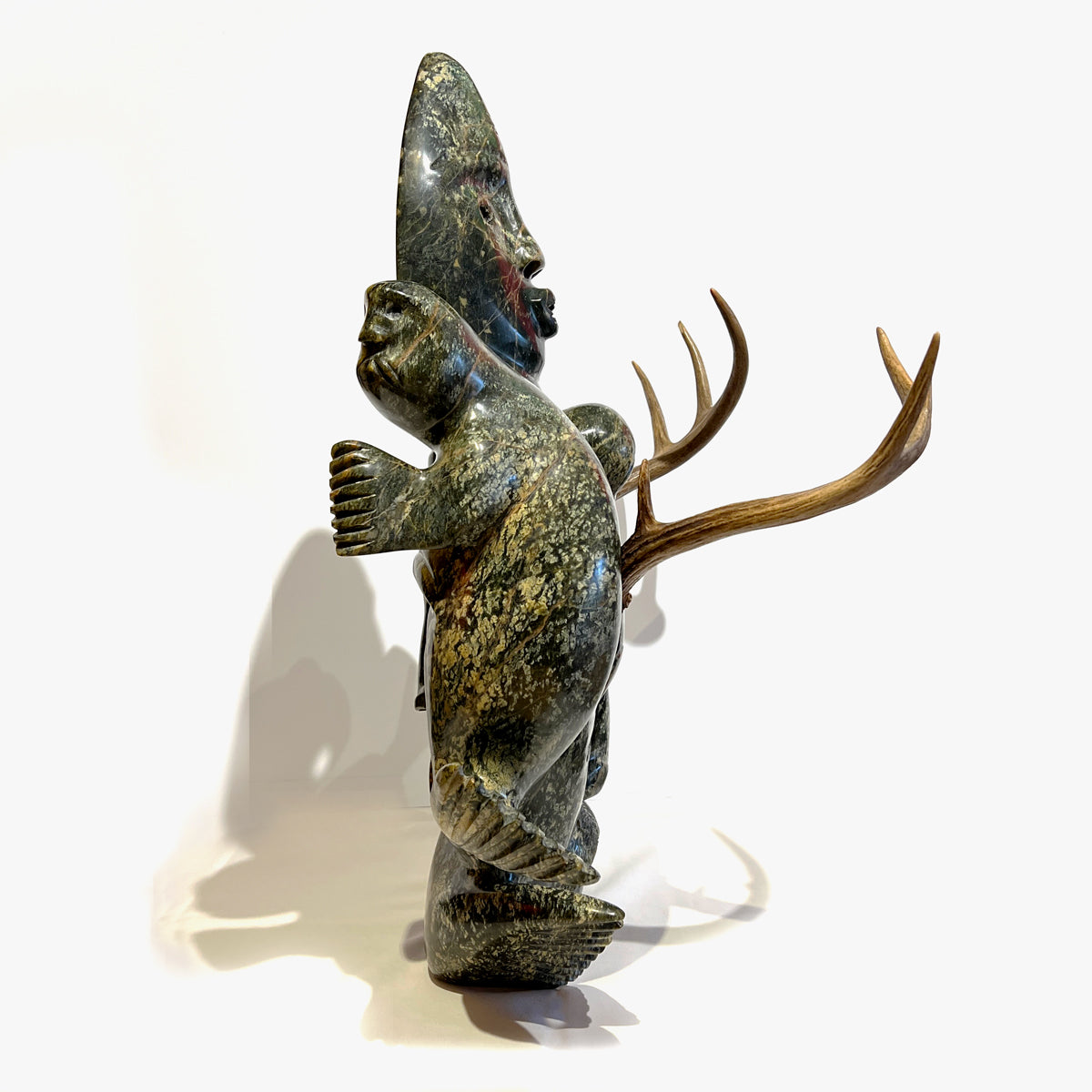
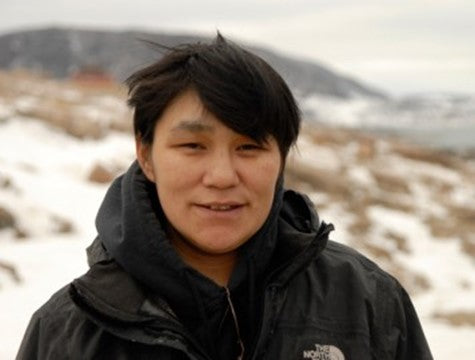
Born in 1979 in Iqaluit, Ningeosiak “Ning” Ashoona grew up in the community of Kinngait (formerly Cape Dorset) after arriving to live on the land with her grandparents and extended family. Her grandmother, Mayoreak, was a defining figure in Ningeosiak’s life, teaching her how to carve mermaids and loons with traditional tools and techniques.
Ningeosiak was born into a family of celebrated artists. Her great grandmother, Sheouak Parr (Mayoreak Ashoona’s mother), was one of the first Inuit women involved in the early Kinngait drawing projects of the 1950’s. On Qaqaq Ashoona’s side of the family, Ningeosiak’s great grandmother was the renowned artist Pitseolak Ashoona, who was among the very first group of artists to create prints, drawings, and paintings for the Kinngait (Cape Dorset) print studio in the early 60s. In 1974 Pitseolak Ashoona became a member of the Royal Canadian Academy of the Arts and in 1977 she received the Order of Canada, one of Canada’s highest honours. Ningeosiaq’s great uncle, Kiugak Ashoona was an acclaimed master sculptor who was also appointed to the Order of Canada in 2000.
Throughout her younger years, Ningeosiak lived with her grandparents in Saturituk, an isolated outpost camp on the southern coast of Baffin Island. Having traveled and camped along the coast with her family during the spring and summer, Ningeosiak gained a deep appreciation for Arctic wildlife at an early age. Both of Ningeosiak’s grandparents were skilled carvers whose work honoured traditional Inuit culture and mythology. Ningeosiak’s grandmother Mayoreak is the most important female figure in her life and ultimately influenced Ningeosiak to become a carver as well. Ningeosiaq credits Mayoreak’s steadfast determination and creativity within the male-dominated art of carving as her greatest inspiration. Of the many Arctic animals that Ningeosiak carves, the loon is her favourite. Her slender, flowing loons possess an elegant, tranquil aspect. Today, Ningeosiak is one of the only full-time female carvers in Kinngait.
Ningeosiak is one of Kinngait’s only full-time female carvers, using both manual and power tools to carve delicate forms out of serpentine and stone. She finishes each of her sculptures off with a high shine to further accentuate their grace and elegance. Ningeosiak has participated in numerous exhibitions across Canada and internationally, and her work represented in major public collections such as the National Gallery of Canada.
Please contact the gallery for more information about the artist. info@nativeartgallery.ca